
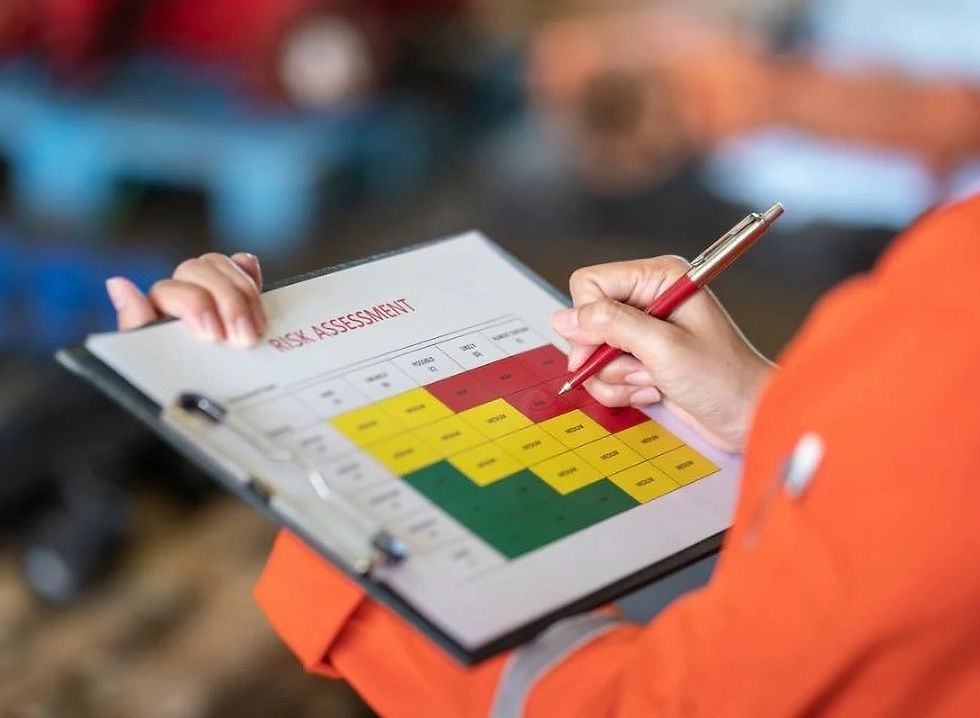

Understand the Value – Why This Course Matters
This course provides participants with practical skills in workplace hazard identification and risk assessment (HIRA), as well as in managing hazards and risks using the hierarchy of controls and other well-established risk control techniques.
Rooted in the ISO 31000 and 31010 “Risk Management” standards and the ANSI/ASSP “Prevention through Design” framework, the training combines foundational principles with real-world applications.
Participants will gain hands-on experience with tools and best practices to effectively control risks and support a proactive safety culture.

This course is ideal for:
Health and Safety Coordinators and Officers
Operations and Maintenance Managers
Team Leaders and Project Supervisors
Facility Managers and Risk Owners
Anyone involved in hazard identification, risk assessment, or control planning
Module 1: Introduction into Risk Management
The value of risk management
Legal requirements for risk management
The most recognized risk management standards
Key risk management terminology
A range of risk assessment techniques and how to select the appropriate one
The context of risk assessment
The composition and competences of the risk assessment team
Module 2: Fundamentals of Risk Management
Identifying hazards and risks
Analyzing risk
Evaluating risk
Determining risk treatment (risk controls)
Recording and reporting
Reviewing risk assessments
Module 3: Field-Level Risk Assessment
Job Safety Analysis (JSA)
Task Hazard Analysis (THA), including dynamic risk assessment tools such as Take 5, SLAM, and STOP
Identify hazards and assess workplace risks using recognized techniques
Apply legal and regulatory principles of risk management
Select and implement appropriate risk control measures
Conduct Job Safety Analysis (JSA) and Task Hazard Analysis (THA) using tools like Take 5, SLAM, and STOP
Document, communicate, and review risk assessments effectively
Contribute to or lead a competent risk assessment team
Online Course (for individual learners):
Join from anywhere in the world and start learning right away!
Enjoy 8-16 hours of flexible, self-paced study, 1 month of access, and unlimited support from our expert instructors.
In-Company Training (for corporate groups of 8–20 participants):
Our expert-led, 1-2-day course is delivered exclusively for your team, at your location or other agreed venue or live via Zoom
Upon successful completion of the course, participants will receive a Certificate of Completion demonstrating knowledge and applied skills in risk assessment and management.
Absolutely. Both the face-to-face and online versions of this course are designed around multiline active learning and practical application. Activities reflect real workplace hazards and risk management challenges, helping participants connect the course content to situations they may encounter in their own organizations.
The face-to-face course includes:
Facilitated group discussions
Breakout team exercises
Realistic workplace scenarios and case studies
Hazard identification using workplace photographs and videos
Risk assessment exercises
Activities involving risk evaluation and prioritization
Selection of appropriate risk controls
Opportunities to practise completing workplace risk assessments
Activities are never included simply for the sake of interaction. Each one has a clear learning purpose: to help participants recognize hazards, assess the associated risks, make informed decisions, select effective controls, and apply a structured risk management process in the workplace.
The online course includes:
Realistic workplace scenarios and case studies
Interactive hazard identification activities
Workplace photograph and video analysis
Knowledge checks and quizzes
Practical risk assessment assignments
Risk evaluation and control-selection exercises
Self-assessments and reflection activities
Downloadable risk assessment tools, templates, and checklists
Although the online course is self-paced, participants are not left to learn from an automated system alone. Knowledge checks provide immediate results, while practical assignments are reviewed by real instructors who are experienced safety professionals. Participants receive personalized feedback to help them strengthen their risk assessments, recognize where they are doing well, and understand how they can improve.